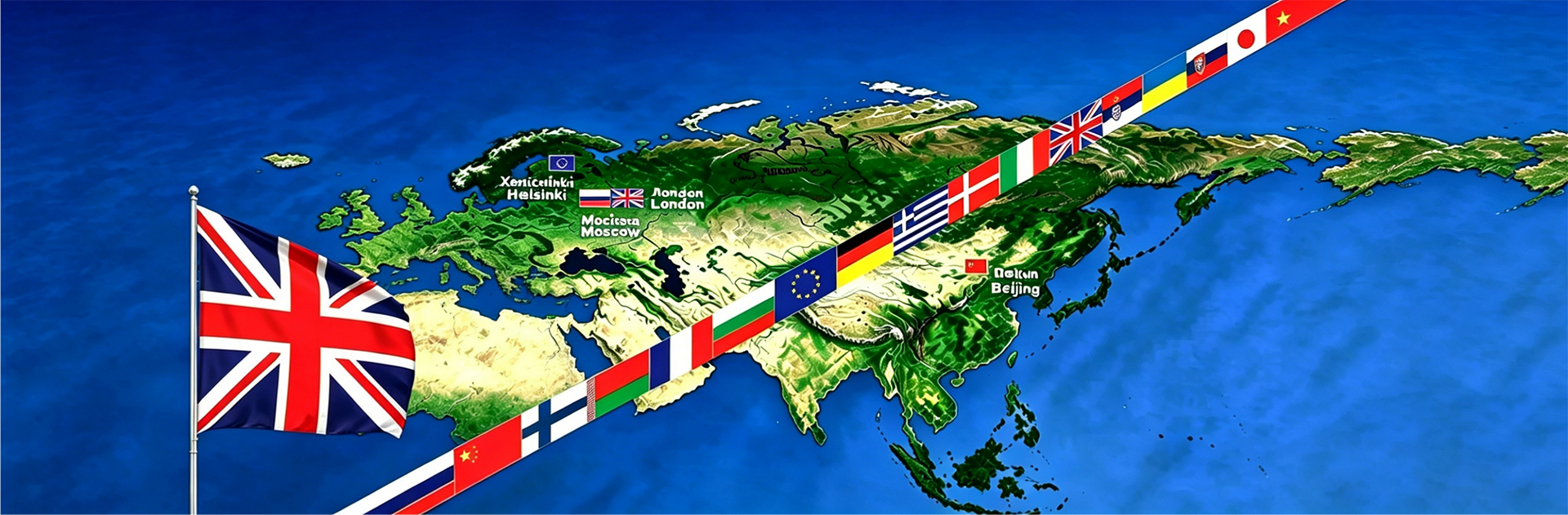
National science centres have been established in the following countries:
Russia, The United Kingdom, China, Finland.
The International Academy of Eurasian Sciences is an international scientific organisation established in January 1994 and registered in the United Nations as a non-governmental organisation of UNESCO. Headquartered in Moscow, Russia, it is composed of the Faculty of Science and the International Science Centre. Its members include more than 600 academicians, academicians and honorary members from 46 countries around the world. They are all famous natural scientists, engineering experts and social scientists from various countries.
Russia, Britain, China, Finland
The International Eurasian Academy of Sciences was established in 1994 on the initiative of several eminent scientists from Europe and Asia. IEAS is a public organisation bringing together scientists, scholars, and prominent actors in culture, art, and social life, involving over five hundred members from eighty-seven countries.
Russian Headquarters (Moscow): The global headquarters of IEAS, located in Moscow and led by IEAS President Academician Valery G. Bondur. The Russian Headquarters coordinates the overall activities of the Academy and hosts the European-Asian Regional Scientific Centre chaired by Academician Vladimir Tikunov, specialising in geoinformatics, cartography, and environmental monitoring across the Eurasian landmass.
Finland Centre (Helsinki): The European Regional Scientific Centre, hosted at the Institute for Atmospheric and Earth System Research (INAR), University of Helsinki, and chaired by Academician Markku Kulmala. The Finland Centre focuses on atmospheric and earth system research, hosting the Pan-Eurasian Experiment (PEEX) coordination office.
China Centre (Beijing): The Asia-Pacific Regional Scientific Centre, chaired by Academician Wang Qinmin, focusing on environmental challenges, green economy, and sustainable development across the Asia-Pacific region.
United Kingdom Centre (UK): Established in 1995 as a key branch of IEAS in Western Europe, dedicated to international technological exchange and scientific collaboration between Eurasia and Europe. The UK Centre operates as a National Scientific Centre under the European Regional Centre while maintaining direct liaison with all three Regional Centres.
IEAS Assembly
The Assembly is the highest decision-making body of IEAS, convened at regular intervals to review major lines of activity, evaluate results, approve Presidium reports, and consider Audit Commission conclusions. All Academicians in good standing are entitled to participate.
IEAS Presidium
The Presidium is the governing body of IEAS between Assemblies, elected for a five-year term. The Presidium includes the President, the Past President, the Presidents of the Regional Centres, Vice Presidents, the Chief Scientific Secretary, and the Presidents of major National Centres with at least thirty members.
IEAS Bureau
The Bureau is formed to address ongoing issues within the Presidium, meeting at regular intervals to review membership applications, approve financial matters, and manage day-to-day affairs of the Academy.
Secretariats
Secretariats are the working bodies of IEAS, formed on the basis of each Regional Centre. The Secretariats are responsible for administrative operations, communications, and coordination across the IEAS network.
IEAS Headquarters
The headquarters of IEAS is determined by the location of the President of the Academy. Currently, the headquarters is located in Moscow.
International Cooperation
IEAS maintains formal and informal relationships with a range of international organisations. These include UNESCO, the World Meteorological Organization (WMO), the International Cartographic Association, the International Geographical Union, and national academies of sciences across Eurasia. The UK Centre shall build upon these relationships while establishing new partnerships with UK-based learned societies and research councils.


The International Academy of Eurasian Sciences is an international scientific organisation established in January 1994 and registered in the United Nations as a non-governmental organisation of UNESCO.
International Eurasian Academy of Sciences UK Centre London, WC2A 2AE United Kingdom
info@ieas.org.uk secretariat@ieas.org.uk fellowship@ieas.org.uk