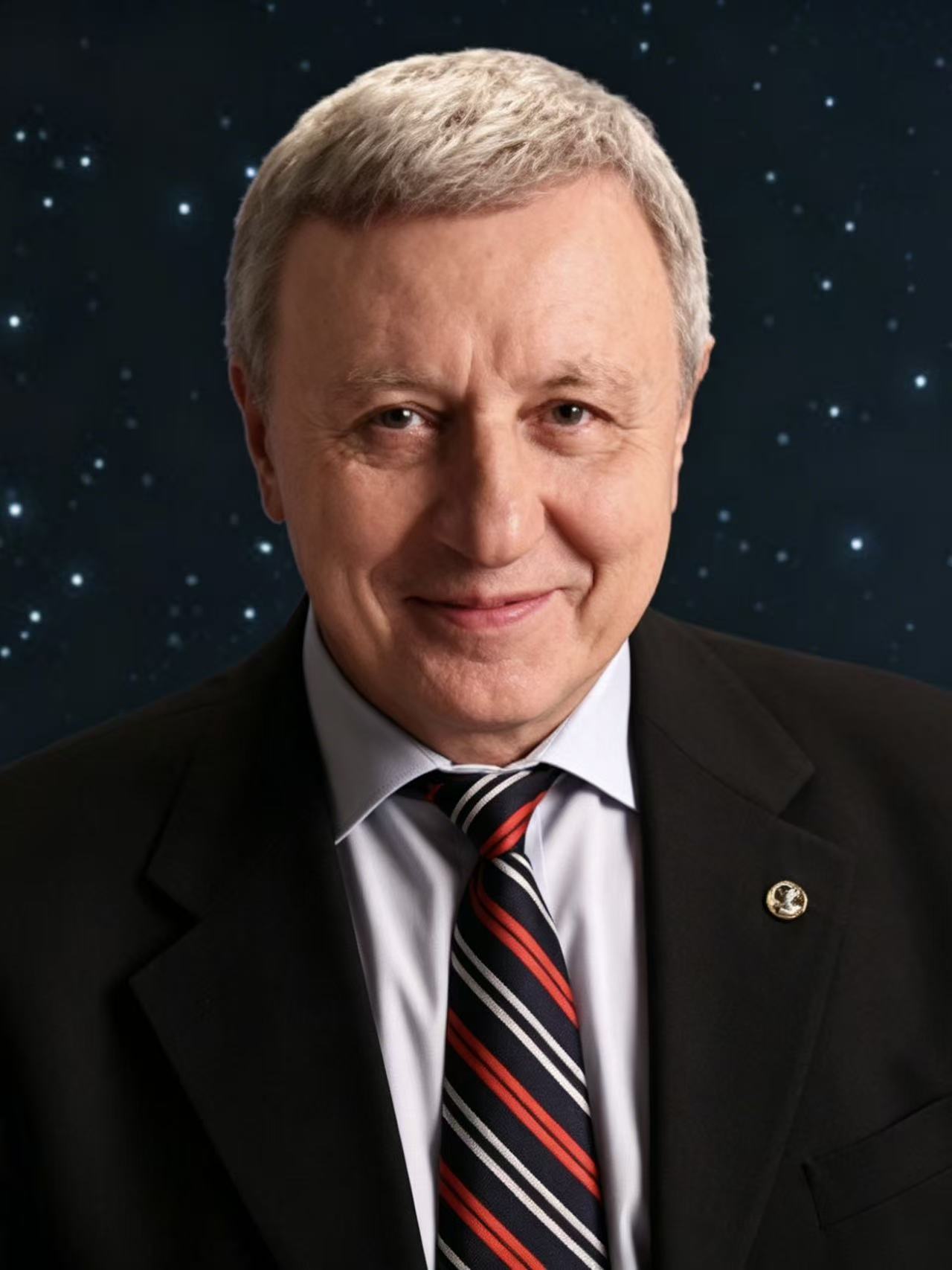
·1968–1972:Studied at the Moscow Power Engineering Institute, graduated with a Bachelor's degree in Space Geosciences.
·1974–1999:Served at the Central Research Institute of Cometa as Engineer, Deputy Director for Research, and Chief Designer.
·1980:Awarded the Candidate of Technical Sciences degree (Ph.D. equivalent), Moscow Power Engineering Institute.
·1990:Awarded the Doctor of Technical Sciences degree.
·1999–2003:Director of the Center for Environmental Monitoring and Information Technology, Central Research Institute of Cometa.
·2000–2018:Director of the Aerospace Monitoring Institute under the Ministry of Science and Higher Education of the Russian Federation.
·2003:Elected Academician of the Russian Academy of Sciences.
·2017:Elected Foreign Academician of the Chinese Academy of Sciences.
·2017–2022:Served as Vice President of the Russian Academy of Sciences.
Professor Bondur's principal academic contributions lie in establishing the theoretical foundations and methodological frameworks for space-based observation systems targeting the oceans, atmosphere, land surfaces, and near-Earth space, and he has achieved systematic accomplishments in natural disaster monitoring, environmental protection, ocean exploration, and related Earth science research. He has developed methods for spatial spectrum measurement of the oceans using remote sensing, multi-frequency radio wave recording techniques, multi-frequency emission tomography, and radiometric measurement approaches; he has devised remote diagnostic techniques for short-term precursors of strong earthquakes, as well as online satellite-based monitoring methods for the atmosphere and ionosphere; and he has established a new class of information features derived from aerospace imaging spectrometry capable of characterising the shape, orientation, and energy distribution of surface objects. Professor Bondur discovered previously unknown early-stage phenomena related to the deformation of the spatial structure of ocean waves, as well as the honeycomb-type structure of the near-surface ocean layer; he revealed systematic changes in geomorphological contour patterns detected on satellite images during the preparation and outbreak phases of earthquakes; and he elucidated the mechanisms governing the interaction between deep-seated hydrophysical fields and surface waves, as well as the near-surface ocean layer. The methods and theories he has proposed have resolved a range of critical challenges in Earth observation and have been implemented in five Russian remote sensing satellite systems, and satellite monitoring initiatives he has launched—including the space-based monitoring of oceans, natural disasters, air pollution, and terrestrial ecosystems—are currently either operational or under active development. He is the author or co-author of over 650 scientific publications, including monographs and peer-reviewed papers, and holds an H-index of 64. His systematic research achievements have established him as a highly influential scientist in the field of space-based Earth observation, both in Russia and internationally.